Following recent investigations into the Eaton Fire and Palisades Fire, new questions have emerged about liability for delayed alerts, blocked escape routes, and injuries sustained during wildfire evacuations.
Wildfires can threaten entire communities within minutes. When evacuation orders are issued in California, getting to safety becomes the top priority. However, escaping the flames does not always mean escaping danger. In many cases, the evacuation route itself presents serious risks. But what happens when someone is injured not by the fire directly, but by the dangerous conditions they encounter while trying to evacuate?
Delayed warnings, gridlocked roads, traffic signals disabled by power outages, and reckless drivers can turn an escape route into a dangerous and chaotic situation. Recent investigations following some of California’s most devastating wildfires—such as the Eaton Fire and the Palisades Fire—have raised questions about whether certain injuries and deaths could have been prevented. They have also highlighted potential failures in emergency alert systems, communication, and evacuation response.
In this article, we examine the main evacuation hazards, when negligence may contribute to injuries, who could be held liable, and what practical and legal steps victims can take to protect their rights.
🔥 Were You Injured While Evacuating a California Wildfire?
If a delayed warning, blocked road, or traffic accident made your escape more dangerous, you may be entitled to compensation. At Adamson Ahdoot, we investigate what happened, identify liable parties, and evaluate your legal options at no cost to you.
Call (866) 645-4992 for a free, confidential consultation, or contact us through our online form.
Trust our experienced California wildfire attorneys to fight for your rights.
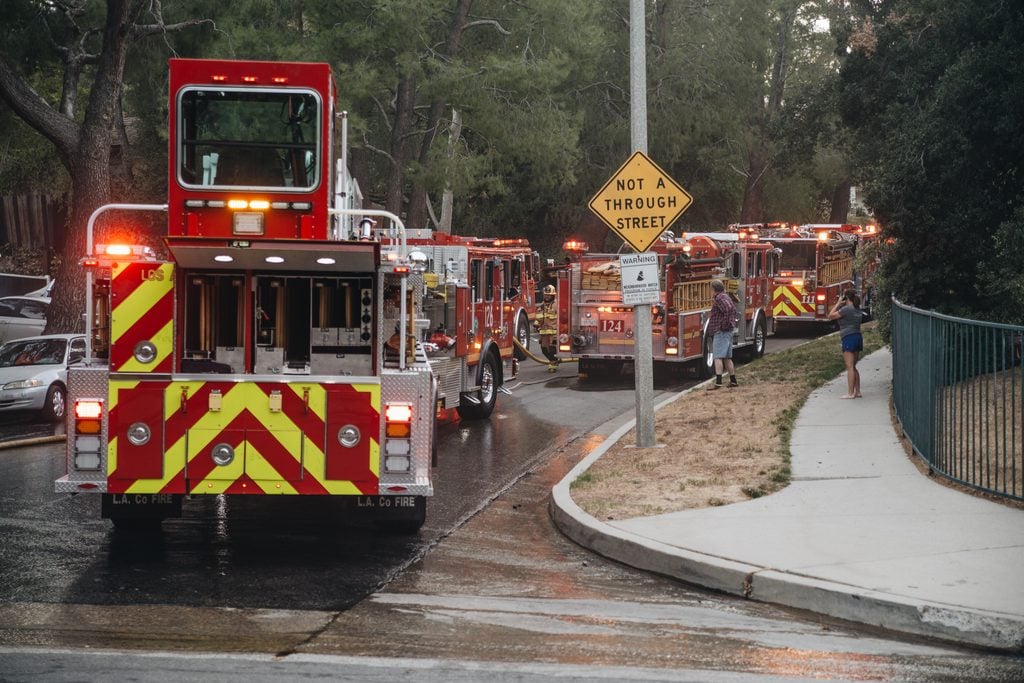
Quick Answer: Can You Sue for an Injury Suffered During a Wildfire Evacuation?
Yes, depending on the circumstances.
You may be able to file a lawsuit if your injuries were caused or aggravated by a third party’s negligence or recklessness during an evacuation. Although wildfires are considered natural disasters, civil liability may arise when a breach of a legal duty of care results in dangerous evacuation conditions that contribute to the resulting harm.
The Chaos of a Wildfire Evacuation in California: When Escaping Also Poses a Risk
When an evacuation order is issued, panic and the rapid spread of flames can turn escape routes into life-threatening environments. However, not all risks that arise during an evacuation are an inevitable consequence of the fire itself. The timing of emergency alerts, the condition and capacity of evacuation routes, and the reliability of communication networks and other vital systems can also affect the safety of those trying to escape.
Key factors that can complicate wildfire evacuations include:
Delayed or Failed Emergency Alerts
An effective evacuation relies heavily on residents receiving clear, timely information. Emergency alert systems, such as Wireless Emergency Alerts (WEAs), and local notification platforms like Nixle are essential tools for helping residents evacuate safely and promptly.
When authorities or responsible agencies issue warnings too late or fail to notify certain neighborhoods, families may be forced to flee as flames approach their homes. This reduces the time available to escape and increases the risk of exposure to smoke, fire, traffic congestion, and other hazards.
Traffic Congestion, Gridlock, and Limited Evacuation Routes
In some California communities, particularly those located in the wildland-urban interface (WUI), access roads and exit routes may be limited. When large numbers of residents attempt to evacuate through the same road network, severe traffic congestion can create gridlock, making it difficult or even temporarily impossible to leave.
Smoke, poor visibility, narrow roads, and emergency response vehicles can further complicate traffic conditions. In these situations, limited evacuation routes may significantly delay residents trying to reach safety.
Power Outages and Communication Failures
During periods of high wildfire risk, utility companies may initiate Public Safety Power Shutoffs (PSPS). These preventive power outages, as well as fire-related electrical failures, can disrupt infrastructure critical to a safe evacuation.
Traffic signals at busy intersections may shut down, cell towers may lose power and disrupt communications, and automated exit gates in gated communities may become inoperable. Without proper coordination or adequate backup measures, these disruptions can increase the risk of serious traffic collisions.
Eaton Fire and Palisades Fire Investigations Put California Evacuations Under Scrutiny
Independent investigations into the devastating Eaton and Palisades fires in Southern California revealed significant shortcomings in emergency coordination and response. Investigative reports identified major issues involving public alerts, communication between agencies, incident command operations, and evacuation procedures.
During their investigation of the Eaton Fire, experts documented significant delays in evacuation warnings in western Altadena. They also discovered failures in relaying crucial information from emergency personnel in the field to those overseeing the response.
The Palisades Fire investigation exposed coordination problems among the agencies responsible for firefighting and evacuation management.
⚖️ Important: These findings do not automatically establish legal liability for every injury or death. However, they underscore the importance of examining when the threat emerged, when evacuation warnings were issued, what information was available to officials, and whether specific operational failures or omissions contributed to the resulting harm.
Common Injuries and Hazards During a Wildfire Evacuation
Injuries sustained during an evacuation are not always caused by direct contact with flames. Traffic congestion, dense smoke, low visibility, and the urgency to flee a threatened area can lead to severe accidents and physical harm.
Potential evacuation-related injuries include:
- Traffic Accident Injuries. Panic, zero-visibility smoke conditions, traffic signals disabled by power outages, and reckless driving on congested roads can result in serious collisions, vehicle rollovers, and pedestrian accidents.
- Smoke Inhalation and Respiratory Damage. Being trapped inside a vehicle during a traffic jam can prolong exposure to smoke and harmful particles. This may cause breathing difficulties, airway injuries, and, in severe cases, long-term lung damage.
- Burns and Heat-Related Injuries. Residents may be forced to flee on foot, exposing them to extreme heat and other thermal hazards while attempting to reach safety.
- Fractures, Traumatic Injuries, and Falls. Rushing to evacuate, especially at night or across uneven terrain, can result in falls, fractures, and other serious injuries.
- Emotional Trauma and PTSD. Fear, uncertainty, and life-threatening experiences during an evacuation can have lasting psychological effects, including post-traumatic stress disorder (PTSD) in some cases.
Who Can Be Held Liable for an Evacuation Injury?
Determining legal responsibility for an injury sustained during an emergency depends on the specific facts of the incident and whether the actions or omissions of an individual, corporation, or public entity contributed to the harm. Although a wildfire itself is a natural disaster, civil liability exists under California personal injury law when negligent conduct exacerbates evacuation hazards and directly leads to physical harm.
Potentially liable parties may include government agencies, counties, utility companies such as PG&E or Southern California Edison (SCE), property owners and developers, negligent drivers, and property management companies.
Civil Liability Scenarios
The following table outlines situations in which evacuation-related injury claims may arise and identifies potentially responsible parties.
| Situation During Evacuation | Potentially Liable Party | Example of Negligence |
|---|---|---|
| Delayed or missing evacuation warnings | Government agency / County | Unreasonable delays or failures to issue emergency alerts through systems such as WEA or Nixle, where a legal duty applies. |
| Road blocked by downed power lines | Utility company (PG&E, SCE) | Negligent maintenance of utility poles or power lines that obstruct a critical evacuation route. |
| Traffic signals disabled during a power outage or PSPS | Utility company / Local transportation agency | Failure to provide required backup power or appropriate traffic control measures at crucial intersections. |
| Collisions during gridlock or poor visibility | Negligent driver | Speeding, distracted driving, or reckless maneuvers that cause collisions during an evacuation. |
| Blocked exits or inadequate evacuation routes | Property owner / Developer / HOA | Failure to maintain private access roads, address known hazards, or comply with applicable fire safety requirements. |
What Happens If the Evacuation Warning Comes Too Late?
When an evacuation order comes too late, people lose the single most valuable resource in an emergency: time. Receiving a delayed alert can leave families with insufficient time to safely escape an area threatened by approaching flames.
However, a late evacuation warning does not automatically constitute legal negligence or guarantee financial recovery. To establish liability, it is necessary to determine whether the entity responsible for issuing these notices breached an applicable duty of care and whether that failure contributed to the resulting injuries.
Key factors in evaluating delayed alert claims include:
- Risk Detection. When the danger was first identified and what information was available to authorities at the time.
- Alert Transmission Records. When warnings were broadcast and received via systems such as WEA or Nixle, and whether avoidable operational delays or command chain breakdowns occurred.
- Causal Connection to the Injuries. Whether the late notification contributed to the injuries and whether an earlier warning could have allowed residents to evacuate more safely.
In California, claims against public entities may also be subject to governmental immunities and special procedural requirements. For this reason, reconstructing the evacuation timeline and determining who was involved are essential steps in assessing potential legal action.
How to Prove a Wildfire Evacuation Injury Claim: The Legal Standard
Under California law, proving liability for injuries sustained during a wildfire evacuation generally requires demonstrating four elements of negligence:
- Duty of Care. The defendant owed the injured person a duty to exercise reasonable care.
- Breach of Duty. The defendant failed to meet that duty.
- Causation. The defendant’s breach was a substantial factor in causing the injuries.
- Damages. The injured person suffered legally compensable injuries or losses.
Evidence plays a critical role in establishing negligence. Emergency alert records, official investigation reports, photographs, videos, witness statements, and medical documentation can help determine what happened, identify potentially liable parties, and demonstrate how their conduct contributed to the injuries.
What to Do After Suffering an Injury During an Evacuation
Even if your injuries seem minor, get medical attention as soon as possible. Some complications from smoke inhalation may not appear until later. Keep copies of all medical records, diagnoses, and bills.
2. Preserve Emergency Alerts and Communications.
Save evacuation alerts, text messages, call logs, photographs, videos, and contact information for potential witnesses. Document the time you received evacuation warnings and when you began leaving the area.
3. Document Evacuation Route Conditions.
If it is safe to do so, photograph any obstacles, blocked roads, nonfunctioning traffic signals, or damage to your vehicle. Preserve any available dashcam footage that may help establish what happened.
4. Be Cautious When Dealing With Insurance Companies.
Report the incident to your own insurance company when appropriate. Avoid speculating about the cause of the accident or signing settlement agreements with third-party insurers before fully understanding their legal implications.
5. Consult a Personal Injury Attorney.
An experienced lawyer can investigate your case, identify liable parties, gather evidence, and assist you in seeking compensation for your injuries and losses.
Deadlines for Filing a Wildfire Evacuation Injury Claim in California
In California, time is of the essence when protecting your rights following a dangerous evacuation. Identifying the potentially liable parties as soon as possible is crucial, as the deadlines for filing a claim depend on who may be responsible for your injuries.
- Claims Against Public Entities: 6 Months
Under the California Government Claims Act (Cal. Gov. Code § 911.2), individuals seeking compensation for personal injuries caused by public entities generally have six months from the date their cause of action accrues to file a formal administrative claim.
Missing this strict deadline can make pursuing compensation significantly more difficult, although certain exceptions and procedures for seeking relief may apply.
- Lawsuits Against Private Entities or Individuals: 2 Years
For personal injury lawsuits against private companies, such as utility providers PG&E or Southern California Edison (SCE), real estate developers, or negligent drivers, California generally allows two years from the date the cause of action accrues to bring a lawsuit (Cal. Code Civ. Proc. § 335.1).
⚠️ Important: If a public entity formally rejects your administrative claim in writing, you generally have six months from the date the written notice is personally delivered or mailed to file a lawsuit.
The Legal Clock Is Ticking: Protect Your Right to Compensation
If your evacuation injury involved delayed emergency alerts, disabled traffic signals, or failures in public evacuation management, your deadline to file a claim against a government entity may already be approaching.
Gathering evidence, conducting investigations, and identifying potentially responsible parties can take time. The attorneys at Adamson Ahdoot can evaluate your circumstances, explain the applicable legal deadlines, and help you take action to protect your rights.
Call (866) 645-4992 today for a free, confidential case evaluation.
What Compensation Can You Recover for Wildfire Evacuation Injuries?
If you suffered injuries during a wildfire evacuation due to another party’s negligence, California personal injury law may allow you to seek economic and non-economic damages to address the financial, physical, and emotional consequences of the incident, including:
- Medical Expenses. Emergency treatment, hospitalization, medications, rehabilitation, and future medical care.
- Lost Wages and Earning Capacity. Income lost while recovering from your injuries and any reduction in your ability to earn a living.
- Pain and Suffering. Physical pain, limitations, and reduced quality of life resulting from your injuries.
- Emotional Distress. Anxiety, post-traumatic stress disorder (PTSD), and other psychological effects associated with the evacuation.
- Property Damage. The cost of repairing or replacing your vehicle and other belongings damaged during the incident.
In wrongful death cases, eligible surviving family members may pursue damages for recognized losses under California law.
⚖️ Note: The available compensation depends on the supporting evidence, the nature and extent of your losses, and the applicable rules governing liability and damages.
How Can an Attorney Help With Your Personal Injury Lawsuit?
Personal injury claims arising from wildfire evacuations can be complex, particularly when government agencies, utility companies, or multiple potentially responsible parties are involved.
An experienced wildfire lawyer can investigate your evacuation, gather evidence, identify liable parties, and evaluate your injuries and losses. They can also negotiate with insurance companies, navigate applicable legal procedures, and help you pursue compensation while protecting your rights and meeting critical filing deadlines.
Get Legal Help Today
An emergency evacuation should help you reach safety, not expose you to additional dangers caused by negligence. If you were injured while fleeing a wildfire in California, you may be entitled to financial recovery.
At Adamson Ahdoot, our lawyers have over 100 years of combined experience representing personal injury victims throughout California. We are committed to protecting your rights and helping you navigate the legal process. We offer:
- Free, Bilingual, and Confidential Consultation. We evaluate the circumstances of your evacuation and address your concerns with no obligation.
- Contingency Fee Representation. You pay no attorney’s fees unless we recover compensation for you.
Don’t wait until legal deadlines limit your options. Call (866) 645-4992 today or complete our online form to speak with our team.